Selling digital products: the 2026 creator playbook

Selling digital products in 2026 is less about the product and more about the stack underneath it. A $29 template, a $199 course, a $9/month plugin — they all live or die on the same three questions: how does the buyer pay, who handles the tax, and when does the money reach you? This playbook walks through the workflow end-to-end, the trade-offs between building and buying, and where a marketplace listing like category on PPToGo fits into the picture.
What selling digital products looks like in 2026
Two years ago, a solo creator could launch a PDF, bolt on a Stripe Payment Link, and call it a business. That still works — until the first cross-border sale. In 2026 the friction has moved. Buyers expect instant delivery, local currency display, and a checkout that does not bounce them to a third-party page they have never heard of. Tax authorities in the EU, UK, and a growing list of US states now expect digital-goods VAT and sales tax to be collected at the point of sale, not reconciled a year later.
What changed in the last twelve months:
- Local payment methods went mainstream. iDEAL, Pix, UPI, and bank transfer are no longer niche — for digital goods in some markets they convert better than cards.
- Marketplace facilitator laws spread. More jurisdictions now push the collection obligation onto the platform rather than the seller, which changes who you need to register with.
- Buyers got pickier about trust signals. A checkout with no recognizable brand, no refund policy link, and no local currency loses the sale before the card form loads.
The old advice — "just use a Payment Link and figure out tax later" — no longer holds once you sell outside your home country. The 2026 version is a deliberate choice between three stacks, and the choice is mostly about how much compliance you want to own.
Why teams care about the stack now
The forcing function is not the product. It is the paperwork that arrives after the product sells.

Consider what a single cross-border sale triggers. A buyer in Germany pays €19 for a template. Someone now has to determine whether that is a B2B or B2C sale, whether VAT applies at the buyer's rate or the seller's, whether a VAT ID was supplied, and whether an invoice meets local formatting rules. Multiply by twenty countries and the admin cost quietly eats the margin on a low-ticket digital good.
There is a second pressure: payout timing. A creator who sells $5,000 of digital products in a month but receives the cash ninety days later is running a business on credit. The gap between "sale" and "money in the bank" is a working-capital problem, and it scales with volume. Platforms that shorten that gap — or make it predictable — are worth more than the headline fee suggests.
And a third: support. When a buyer's card declines at 2am in a timezone you are asleep in, the difference between a platform with real human support and one with a ticket queue is the difference between a recovered sale and a refund request.
This is the context in which PPToGo positions itself — a low-cost, flexible layer for selling digital goods globally, aimed at indie developers, AI tool vendors, and creators who do not want to become tax accountants. Whether that fits depends on your volume, your markets, and how much of the stack you want to keep in-house. The use cases page is a reasonable place to sanity-check your own situation against theirs.
The end-to-end workflow, broken down
Every digital-product business runs the same six stages. The stack you pick is really a decision about which stages you own and which you outsource.
Stage 1 — Product and delivery
You have the file, the license key, the course, or the SaaS seat. Delivery has to be instant and repeatable: a download link that does not expire before the buyer clicks it, a license key that activates on first use, or a seat that provisions on payment. The decision here is whether delivery lives on your own infrastructure or on the platform's.
- Own it: full control, more to maintain, more to break.
- Outsource it: faster to launch, less control over the buyer experience.
Stage 2 — Checkout and payment methods
This is where most of the conversion is won or lost. A checkout that only accepts Visa and Mastercard leaves money on the table in markets where wallets and bank transfers dominate. The decision is which payment methods to enable and in which currencies to display prices.
- Card-only is the simplest and the most limiting.
- Local methods lift conversion but add reconciliation complexity.
- Currency display affects perceived price more than the actual number does.
Stage 3 — Tax and compliance
VAT, sales tax, GST, and digital-services tax. This is the stage that pushes creators toward a merchant-of-record model, where the platform takes on the collection obligation. The decision is whether you register and remit yourself or hand the obligation to a platform.
- Self-remit: cheaper per transaction, heavier admin, higher risk of a missed filing.
- Merchant of record: higher effective fee, the platform owns the filing.
Stage 4 — Fulfilment and access control
Who gets access, for how long, and how do you revoke it on a refund or chargeback? For SaaS this is entitlement management; for a course it is login-gated content; for a template it is a download link. The decision is how tightly access is tied to payment status.
Stage 5 — Payouts
When and how the money reaches you. Hold periods, minimum payout thresholds, and currency conversion all matter here. The decision is your tolerance for a gap between sale and settlement.
- Short hold, higher fee: better cash flow, thinner margin.
- Long hold, lower fee: better margin, more working capital tied up.
Stage 6 — Reporting and reconciliation
At the end of the month, someone has to reconcile sales, fees, refunds, and tax. The decision is whether the platform's dashboard is good enough or whether you need to export into your own accounting.
Pro tip: Before you commit to any stack, run one real transaction end-to-end — a $1 test product, a real card, a real refund. The places where the flow breaks (tax line items, payout timing, refund handling) are the places that will cost you at scale, and they are invisible until you actually process a sale.
What good looks like (and what to avoid)
Good looks unglamorous. A buyer lands on a page, sees a price in their own currency, pays with a method they recognize, and gets access within seconds. A receipt arrives that satisfies their local tax authority. A month later the money is in your account, and the reconciliation matches the dashboard to the cent.
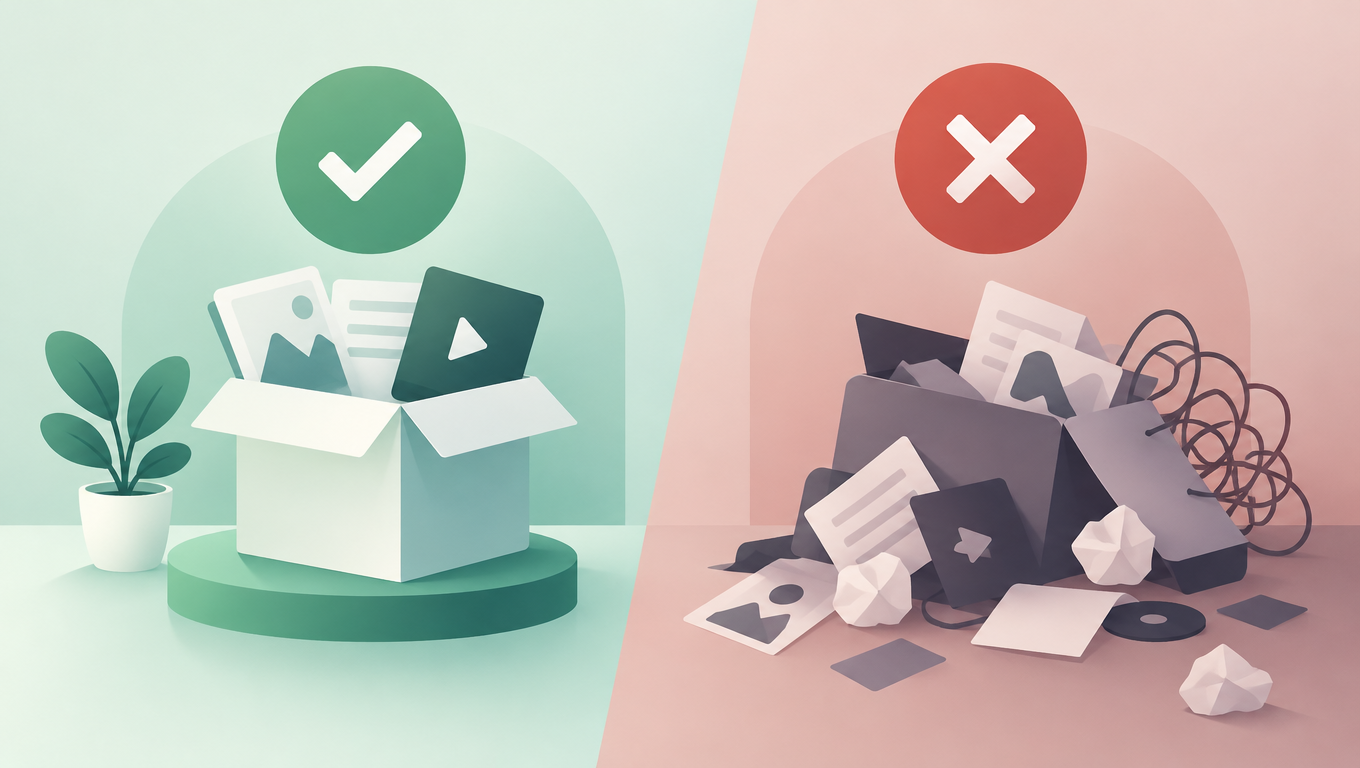
Concrete success criteria worth tracking:
- Checkout completion rate by market — a big gap between two countries usually means a missing local payment method, not a pricing problem.
- Time from sale to settled funds — the working-capital number that quietly determines how fast you can reinvest.
- Refund and chargeback rate — a spike usually traces back to unclear delivery or a mismatched product description.
- Tax filing accuracy — measured by the absence of letters from a tax authority, not by a dashboard metric.
Anti-patterns to avoid:
- Optimizing fees before volume. Chasing the lowest headline rate when you are doing fifty sales a month is a rounding error; the admin cost of self-managing tax dwarfs it.
- Ignoring local payment methods. Assuming cards are universal is the single most common conversion leak for digital goods.
- Treating payouts as an afterthought. A ninety-day hold on a fast-growing product is a cash-flow trap.
- No refund policy link at checkout. Buyers read it as a trust signal even when they never use it.
Tools and approaches: a tour of the landscape
There is no single right answer here — only a set of trade-offs. Broadly, three approaches dominate.
| Approach | Who it suits | Tax handling | Trade-off |
|---|---|---|---|
| DIY stack (gateway + own tax logic) | Technical founders with high volume and in-house accounting | You register and remit | Lowest per-transaction cost, highest admin load |
| All-in-one creator platform | Solo creators selling courses, templates, memberships | Usually merchant of record | Fast to launch, less control over checkout and data |
| Marketplace listing | Vendors who want distribution alongside payments | Depends on the marketplace | Access to an existing audience, less control over pricing presentation |
The DIY route is the cheapest on paper and the most expensive in time. It makes sense once you have real volume and someone who genuinely enjoys tax filings. The all-in-one creator platform is the default for solo sellers who want to focus on the product. The marketplace route is different in kind — it is less about payments and more about distribution, and it is where a listing like category sits: a tool listed on PPToGo, discoverable by creators and merchants already browsing the marketplace.
PPToGo itself sits in the marketplace-and-payments layer. It is built for indie software developers, AI tool vendors, and digital creators who want affordable processing and global reach without becoming tax specialists. It is not trying to be everything — it is one option among several, and the honest way to evaluate it is against your own volume, markets, and appetite for admin. The pricing page and the merchant overview are where the specifics live; the tools directory shows what else is listed alongside it.
Common questions
What counts as a digital product?
Anything delivered electronically: software, license keys, templates, courses, memberships, ebooks, audio, presets, and AI tool access. The defining feature is that there is no physical shipment, which is exactly why tax treatment differs from physical goods.
Do I need a merchant of record?
Not always. If you sell only domestically and in low volume, self-remitting may be simpler. Once you sell across borders at any scale, the compliance load usually makes a merchant-of-record model worth the higher fee.
Why do local payment methods matter for digital goods?
Because in several markets they are the default, not the alternative. A buyer who expects to pay by bank transfer and is shown a card form often abandons the purchase entirely.
How long should a payout hold be?
Short enough that you can reinvest, long enough to cover refunds and chargebacks. The right number depends on your refund rate and your cash buffer — not on the platform's default.
Is a marketplace listing better than my own store?
They solve different problems. Your own store gives you control and data; a marketplace gives you distribution and an existing audience. Many sellers run both and let the marketplace handle discovery.
What should I check before clicking through to a listed tool?
Whether it fits your stack, what it costs, and what the refund and support terms are. Read the listing carefully — the description is the source of truth, not the marketing around it.
How do I know if my current stack is leaking money?
Look at checkout completion by market and time-to-settlement. A wide gap between two countries usually points to a missing payment method; a long settlement gap points to a cash-flow cost you may not have priced in.
Where to go from here
Selling digital products in 2026 rewards sellers who pick a stack deliberately rather than by default. The product is the easy part; the checkout, the tax, and the payout timing are where the margin actually lives. Start by mapping your own six stages, then decide which ones you want to own. If a marketplace-listed tool fits the gap, category on PPToGo is one place to look — and the creator overview shows how the marketplace side works for people selling rather than buying.